



To develop a functional food product, a company must not only have an idea but also go through many stages, from research and formulation, ingredient selection, and quality assessment to preparing the relevant legal documentation. For companies that do not yet have a dedicated research team, partnering with an experienced provider in the field of functional food research and contract manufacturing can help guide the product development process, select appropriate solutions, and minimize potential risks.
At Life Gift, product research and development (R&D) is guided by customer needs and combines formulation development, dosage form selection, and manufacturing feasibility assessment. This process aims to develop products that meet market demands while complying with quality standards, food safety requirements, and manufacturing conditions as specified for each product category.
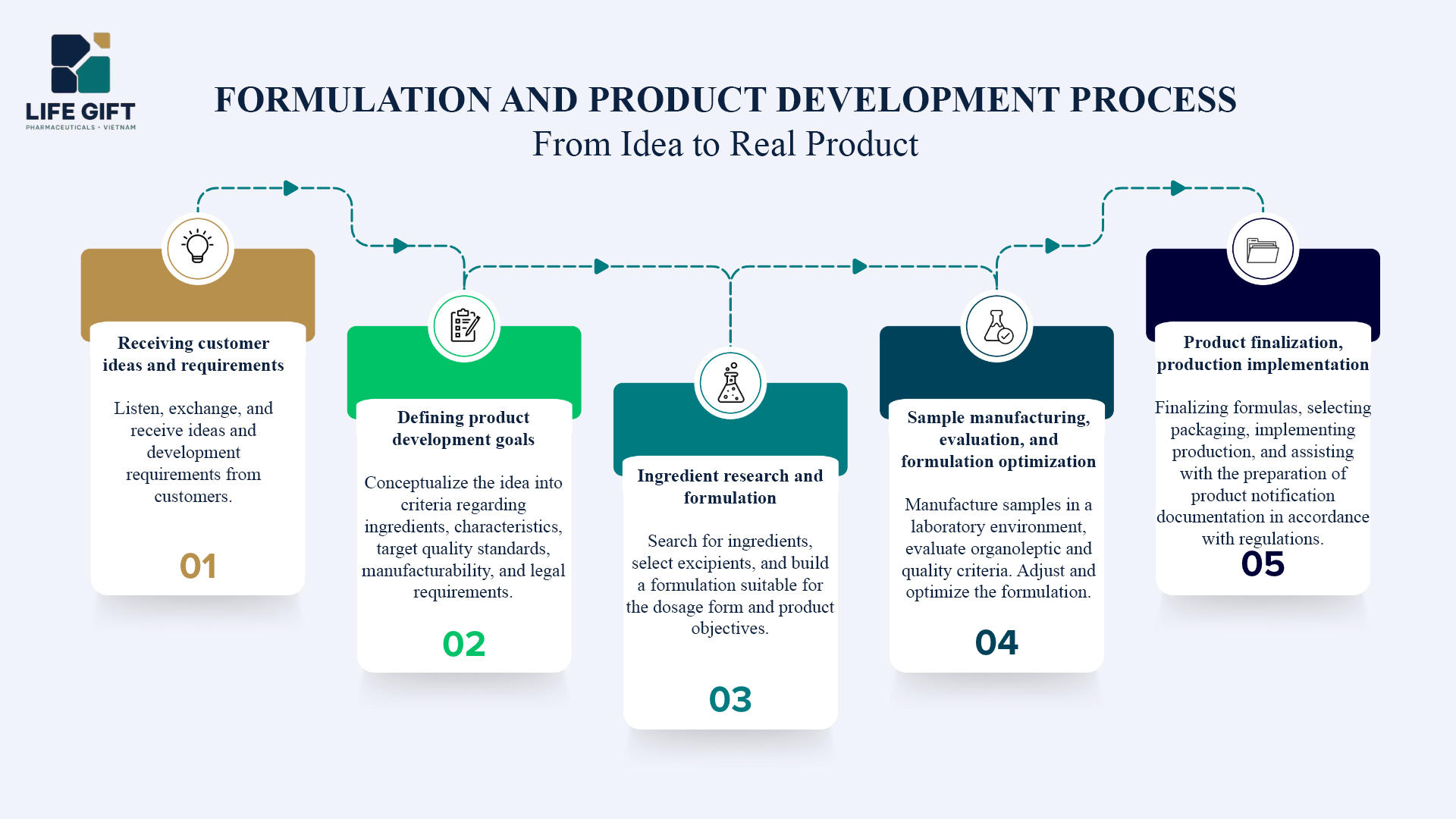
Step 1. Gather the client’s ideas and requirements
The first step in the functional food formulation process is to gather information and understand the client’s product development needs. At this stage, the client may already have ideas, desired ingredients, or reference products available on the market. Based on this initial information, Life Gift’s R&D department will discuss, consult, and propose suitable product development solutions—ranging from defining the product’s benefits, target audience, ingredient selection, and dosage form to pricing segments and packaging specifications. Even without a specific formula, clients will receive support in researching and developing a formula aligned with their product development direction and business objectives.
For example, a client wants to develop a plant-based milk product enriched with nutrients that support bone and joint health, suitable for older adults, people at risk of osteoporosis, and vegetarians. Based on this requirement, the R&D department will advise on the selection of appropriate nutritional ingredients, evaluate their content and bioavailability, and develop a formula while adjusting the flavor to meet the needs of the target group.
Providing consultation and guidance on product development from the very beginning helps clearly define research objectives, minimizes unnecessary adjustments during the formulation process, and saves the client both time and money.
Step 2. Define Product Development Goals
After receiving a request, the R&D department will translate the idea into specific technical and quality criteria. These criteria serve as the foundation for formulating the product, establishing quality standards, and evaluating the product in subsequent stages. Depending on the characteristics of each product, these criteria may include:
- Ingredients and expected concentrations: Consistent with the intended use, target audience, and relevant regulations regarding product ingredients.
- Product Form Characteristics: Determine requirements such as solubility, dispersibility, uniformity, and ease of use, depending on the characteristics of each product form.
- Sensory Characteristics: Determine the requirements for color, taste, and appearance appropriate for the target audience.
- Quality and Stability Requirements: Define the quality parameters to be evaluated, as well as the stability requirements and the target shelf life of the product.
- Production Capacity and Estimated Costs: Assess the actual production capacity for the product while taking into account the costs of raw materials, manufacturing, and packaging to align with the price point desired by customers.
- Legal Requirements and Notification Documentation: Review the product classification, ingredients, and intended uses to guide the preparation of notification documentation in accordance with current regulations.
These criteria provide the R&D department with a basis for selecting raw materials, developing formulations, and evaluating the extent to which the product meets requirements in subsequent stages.
Step 3. Research ingredients and develop functional food formulas
After defining the product development objectives, the R&D department reviews scientific literature, evaluates, and selects ingredients suitable for the intended use. This process involves reviewing scientific evidence regarding efficacy, safety, dosage levels, raw material characteristics, and relevant legal requirements.
In addition to the active ingredients that support health, the R&D department also researches and selects appropriate excipients to develop the formulation. Depending on the product form, excipients may be used to improve taste, support the granulation process, enhance the flowability of powder mixtures, or facilitate the capsule filling and tablet compression processes. Depending on the dosage form, the formulation process will focus on different technical requirements:
- Granular Form: Study of granulation properties, uniformity, moisture absorption characteristics, and solubility or dispersibility based on the intended use.
- Powder Form: Study the particle size, blendability, uniformity, and moisture absorption characteristics of the mixture. For beverages, taste and dispersibility or solubility should also be considered.
- Hard capsules: Consider the compatibility of the ingredients, the flow properties, and the bulk density of the powder or granule mixture to select the appropriate capsule size.
- Tablets: Research on the selection of excipients and appropriate tableting methods to ensure tableting feasibility, mass uniformity, mechanical strength, and disintegration characteristics of the product.
- Film-coated tablets: Research into coating materials and conditions to create a uniform coating, improve appearance, mask taste, or help protect the core tablet in accordance with product objectives.
In addition to developing formulations, the R&D department also assesses feasibility based on raw material characteristics, formulation potential, raw material supply, and production costs. Through this process, potential challenges—such as ingredients that are prone to moisture absorption, powder mixtures that do not flow well, or formulations that are incompatible with the intended dosage form—can be identified early so that appropriate adjustments can be made.
Step 4. Formulation, Evaluation, and Optimization of the Formula
After selecting a formulation, the R&D department proceeds to develop a prototype on a laboratory scale to evaluate the compatibility of the ingredients and the product’s initial characteristics. Depending on the dosage form, the product sample is evaluated for color, taste, physical state, uniformity, solubility or dispersibility, and other relevant quality parameters.
For example, for powdered beverages, the R&D department will evaluate solubility or dispersibility in water, taste and odor, and the tendency to clump. For capsules and tablets, the evaluation process focuses on the characteristics of the raw material mixture, the ability to fill capsules or tableting, and the quality of the finished product.
Based on the evaluation results, the formulation can be adjusted in terms of ingredient ratios, excipient types, or manufacturing methods to improve product quality.
The formulation and evaluation process may involve multiple rounds of adjustments to select a formulation that meets the specified technical and quality criteria.
Step 5. Finalize the product, begin production, and assist with the notification documentation
Once the product prototype meets the established criteria, the R&D department refines the formula, selects raw materials and packaging, and prepares the necessary technical documentation to move on to the production phase.
Before commencing commercial production, the formulation can be evaluated on a larger scale to determine its suitability for the equipment, manufacturing processes, and quality requirements. In parallel with the product development process, Life Gift assists in preparing documentation related to ingredients, formulations, quality standards, test results, and the necessary technical records to support product registration in accordance with current regulations and the agreed-upon scope of services.
The combination of formulation research, production feasibility assessments, and support with regulatory filings helps customers ensure they are fully prepared before bringing their products to market.
Life Gift – Partnering with Our Customers in Formulation Development and Contract Manufacturing of Dietary Supplements
Developing a functional food product requires a combination of business ideas, scientific foundations, formulation techniques, and practical manufacturing capabilities. Each stage—from formula research to product finalization—plays a crucial role in ensuring the product’s quality and feasibility.
With extensive experience in dietary supplement formulation research and manufacturing, Life Gift partners with clients from the initial concept stage, providing tailored solutions and guiding them step by step to turn their ideas into products that meet market demands and align with their brand development strategies.
Contact Life Gift to share your ideas and explore research and product development solutions tailored to your business needs.
Thuy Vy
Related Posts