


In the healthcare industry, a product idea can only reach the market once it has been transformed into a suitable formulation, has a viable production plan, and meets quality and regulatory requirements. A functional food CDMO is a collaborative model that helps businesses connect these development and manufacturing stages with a specialized partner.
At Life Gift Vietnam, CDMO is our approach to collaborating with businesses in the fields of functional foods, health-promoting foods, and products related to herbal medicine and traditional medicine. Each project is discussed based on specific requirements, the scope of our capabilities, and applicable legal conditions.
What Is a Functional Food CDMO?
Definition of the CDMO Model in the Pharmaceutical and Functional Food Industries
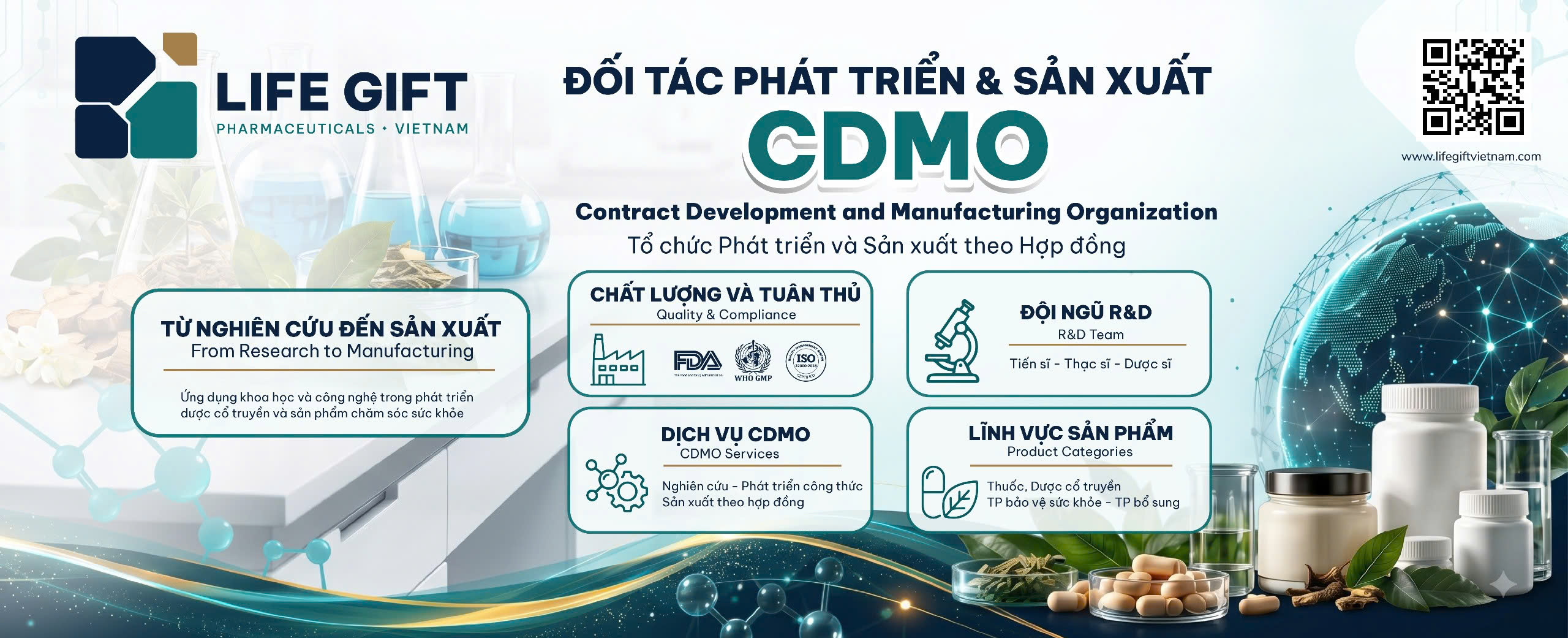
CDMO stands for Contract Development and Manufacturing Organization, which refers to an organization that provides contract development and manufacturing services.
Unlike models that focus solely on the manufacturing stage, a CDMO can be involved as early as the product development phase. Depending on the agreement, the scope of work may include
- Discuss and define the product line.
- Research, refine the formula, and select the appropriate dosage form.
- Assess the feasibility of the production process.
- Organize production, quality control, and packaging of finished products.
The term “CDMO” is widely used in the pharmaceutical industry. In the functional food sector, this model is also applied to describe the integration of product development and contract manufacturing. The actual scope must be clearly defined for each project; the term “CDMO” does not replace the licenses, manufacturing conditions, or legal requirements applicable to each product.
Distinguishing Between the Concepts of CDMO, OEM, and ODM
The terms OEM, ODM, and CDMO are sometimes used differently among businesses. In general, they can be understood as follows:
- OEMs typically emphasize manufacturing based on customer specifications or drawings.
- ODM typically involves the manufacturer’s participation in the product design or development phase.
- CDMO emphasizes the integration of product development and contract manufacturing.
When seeking a partner, a business should base its decision on the actual scope of work rather than just the title. It is important to clarify which stages the partner will be involved in, which parts the client will be responsible for, and which documents will be handed over after each stage.
Significant Benefits of Contract Manufacturing for Functional Foods
Developing new products often requires significant resources: knowledge of raw materials, formulations, production technology, quality control, and related documentation. Not every business needs to invest in all of these resources right from the start.
Collaborating with a CDMO Partner Offers Many Strategic Advantages
- Access to technical expertise and manufacturing capabilities: collaborate with organizations that have experience relevant to the planned product line.
- Conduct a feasibility assessment earlier: review the formula, product form, raw materials, and production requirements before implementation.
- Focus on core business operations: Companies can prioritize market research, brand development, and distribution systems, while delegating specialized tasks to a CDMO partner.
- Clarify responsibilities among the parties: agree from the outset on the formulation, raw materials, quality standards, documentation, timeline, and projected output. A CDMO does not eliminate requirements related to investment, testing, or legal compliance. The value of this model lies in helping the parties coordinate more systematically and clearly define the tasks that need to be completed to move the project forward.
A 5-Step Process for Standardized Functional Food CDMO Collaboration
The process may vary depending on the product and the scope of the collaboration, but it typically begins with identifying requirements and assessing feasibility.
- Product Requirement Discussion: The company shares its product objectives, target customer groups, desired product types, target markets, and estimated production volumes.
- Evaluation of Development Plans: The two parties discussed formulas, ingredients, specifications, quality requirements, and additional information needed to assess feasibility.
- Agree on Scope and Responsibilities: The parties shall identify the tasks, the documents to be provided, the acceptance criteria, the projected timeline, and the responsibilities related to documentation, labeling, and packaging.
- Prototype Development and Evaluation: Depending on the agreement, prototypes or technical proposals are reviewed before proceeding to the production stage. The results must be evaluated according to agreed-upon criteria.
- Production and Coordination of Subsequent Steps: Production is carried out in accordance with the documentation, quality requirements, facility conditions, and applicable regulations. Post-production steps are carried out in accordance with the scope of responsibilities assigned to each party.
Criteria for Selecting a Reputable CDMO Partner
The right CDMO partner must meet the specific requirements of the product and project. Companies should consider the following:
- The range of products and dosage forms that the facility can produce;
- Applicable conditions, permits, and quality standards;
- Methods for controlling raw materials, processes, and finished products;
- Ability to exchange technical information, provide documentation, and coordinate the handling of changes;
- Mechanisms for securing formulas, data, and business information;
- How to determine costs, minimum output, timelines, and the responsibilities of each party.
- The evaluation should be based on the facility’s documentation and actual information, and should be tailored to the type of product planned for production. A clear communication process from the outset helps minimize differences in expectations during the collaboration.
Life Gift Vietnam – A Vision for High-Quality CDMO Partnerships
Life Gift Vietnam is focused on developing its CDMO operations in the fields of functional foods and products related to herbal medicine and traditional medicine. The company works closely with clients to discuss ideas, formulations, ingredients, product forms, and manufacturing plans based on the specific scope of the collaboration.
Each project has its own specific requirements regarding the market, standards, specifications, and documentation. Therefore, Life Gift prioritizes an initial consultation to understand the client’s objectives, identify any missing information, and assess feasibility before finalizing a plan.
Companies seeking partners for the development and contract manufacturing of dietary supplements may contact Life Gift Vietnam to discuss their needs, technical requirements, and the appropriate scope of cooperation.
Frequently Asked Questions About Functional Food CDMO (FAQ)
Does a functional food CDMO include formulation research?
It is possible, depending on the entity’s capabilities and the terms of the agreement. The business should clearly define who owns the formula, the scope of the agreement, the criteria for evaluating samples, and the documents to be transferred.
Is the CDMO responsible for bringing the product to market?
This is not automatic. Responsibilities regarding documentation, disclosure, labeling, distribution, and other obligations must be specifically defined according to each party’s role and the applicable regulations.
What information should you provide when contacting a CDMO?
Companies should prepare a product description, the desired dosage form, ingredients or formulation guidelines, the target market, packaging specifications, and estimated production volume. If a complete formulation is not yet available, you can start by outlining the product’s objectives and concept to facilitate initial discussions between the two parties.
Life Gift VN
Related Posts